From a whiteboard to work instructions in under a week.
Every arrow on the board is a routing step. Every box is an operation. Every circled QA is a hold. The hard part, deciding how the thing actually gets built, was already done by whoever picked up the marker. What is left is transcription, and transcription does not take eighteen months.
By Javier Ortiz
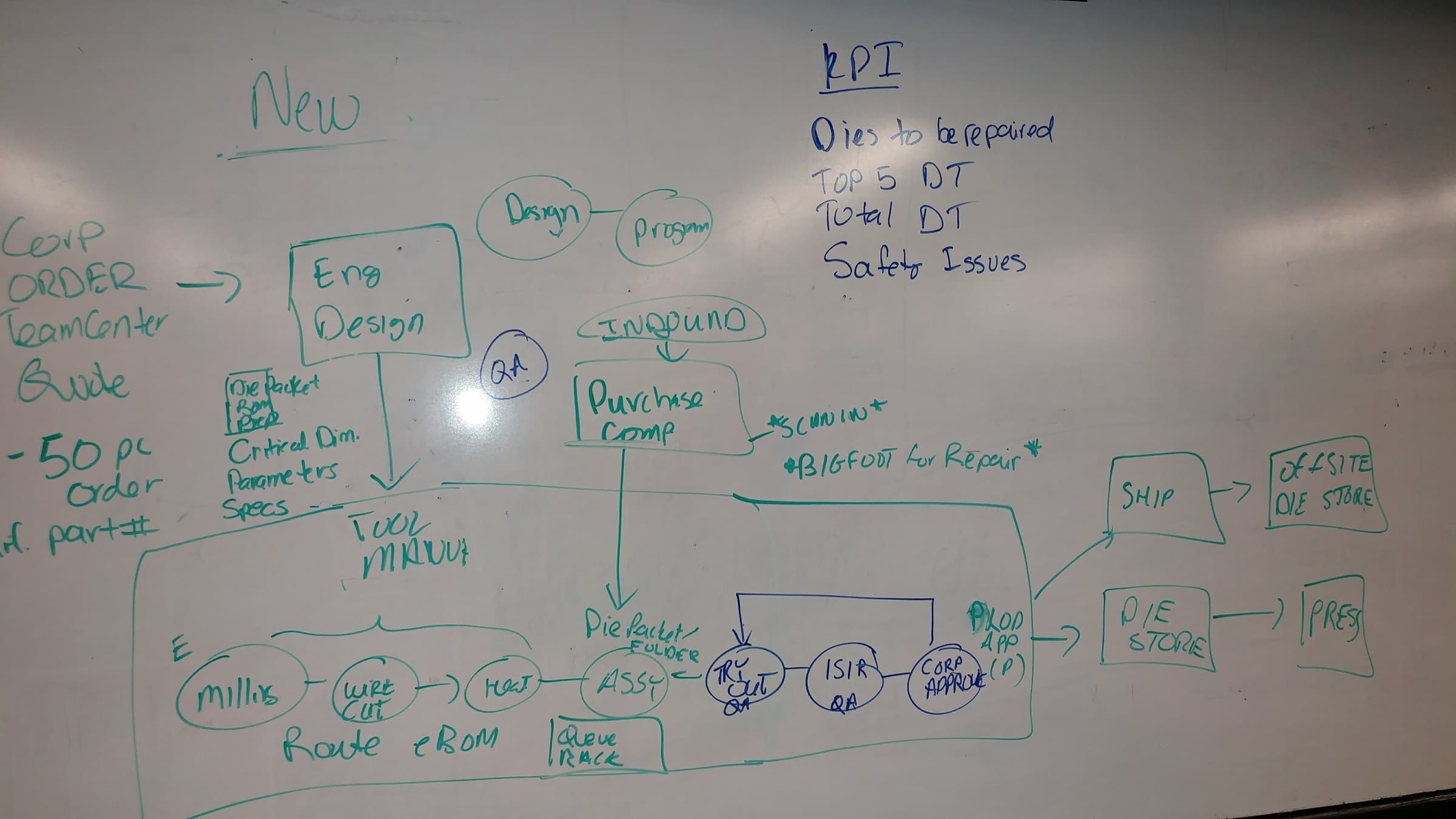
A real board from a real discovery session. Eight operations, three quality holds, two approvals, one routing. Nobody had typed any of it into anything.
Your process is already documented. Just not in a form anyone calls documentation.
Walk into almost any plant in the 30 to 150 employee range and the process exists in four or five places at once. A board in the quality office that nobody has erased in two years. A routing sheet in a binder. A laminated page taped to the station. A training checklist somebody made for the last new hire. And a senior operator who can walk the whole thing in twenty minutes if you ask.
None of that is a work instruction. All of it is the raw material for one, and it is considerably better raw material than a blank template, which is what most work instruction projects start from.
This matters because of where the time actually goes. Work instruction projects do not run long because writing steps is slow. They run long because the plant has to decide what the process is, route the answer through three reviews, and configure a platform before anything can be written into it. Starting from a drawing that already exists removes the first of those, and starting on one line removes the other two.
The six steps
Days shown are where each step lands inside a Launch Pilot, where our team does the first pass alongside yours.
Send the photograph
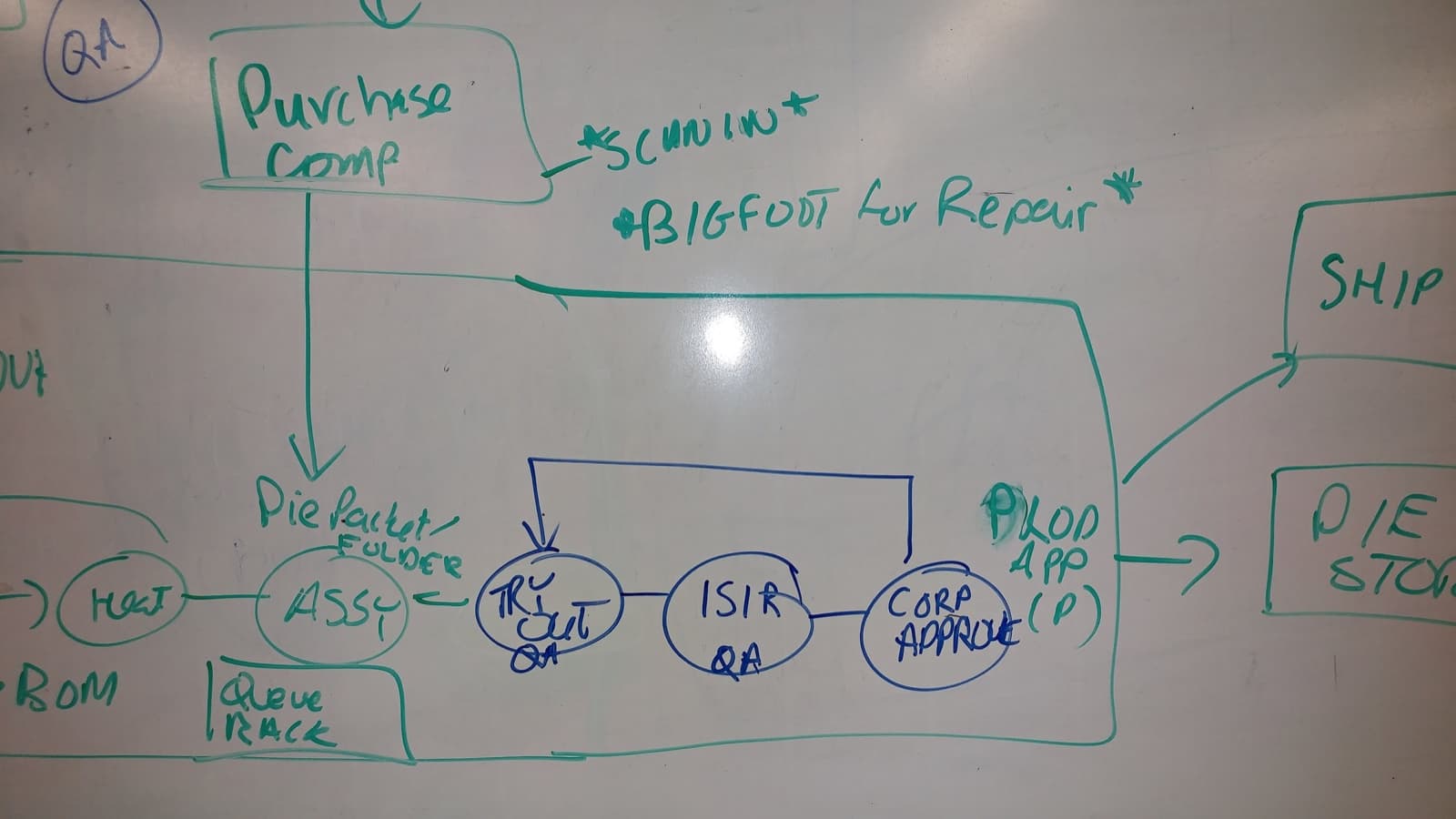
Day 0A phone photo of the board is enough. So is a scan of the routing sheet, a marked-up drawing, or a screen recording of someone walking the line. What matters is that the sequence exists somewhere outside one person's head, which in almost every plant it already does.
Read the routing off it
Day 1Every arrow is a routing step. Every box is an operation. Every circled QA is a hold. We pull the operations, the sequence, the branches and the gates out of the drawing and put the result in front of you as a list, because that is the fastest way to find out what the board left out.
Confirm the gaps with the person who knows
Day 1Boards are shorthand. They leave out the torque value, the fixture number, the thing everyone knows about the second shift. Thirty minutes with the senior operator or the manufacturing engineer closes most of it, and this is the step that decides whether the result is any good.
Author the steps
Days 2 to 3Each operation becomes a work instruction with the content the step actually needs. A photo of what right looks like, three minutes of video on the tricky assembly, the spec extracted from the PDF, the CAD view for the orientation nobody gets right the first time.
Add the checks and the record
Day 3The quality gates from the board become checkpoints in the sequence, with their spec limits. The unit identity gets attached so the job writes an as-built record as it runs. This is the step that turns a set of instructions into a system of record.
Run a real job on it
Days 4 to 5Not a demo. A real job, at the real station, with the operator who does it every day. What they push back on in the first hour is worth more than a week of review meetings, and it gets fixed the same afternoon.
Why this is days and a traditional rollout is months
Nothing above is clever. The difference is entirely in what is not happening alongside it.
There is no data model to agree on before the first instruction can exist, because the instruction is the model. There is no plant-wide scope to negotiate, because the scope is one line. There is no integration to stand up, because a work instruction at a station does not need to talk to anything to be useful on day one. And there is no committee, because six operations on one line is a decision a manufacturing engineer can make on their own authority.
Every one of those is a real requirement at some point. None of them is a requirement before the first operator sees the first step, and treating them as though they are is most of the reason this category has a reputation for taking a year.
Common questions
How long does it actually take to create digital work instructions?
With the process already documented somewhere and someone available to answer questions, a first line can be running in under a week. The authoring itself is days of work. What normally makes work instruction projects take months is not the authoring, it is deciding what the process is, waiting for reviews, and configuring a platform before anything can be written in it.
What if our process is not documented anywhere?
It almost always is, just not in a form anyone would call documentation. A whiteboard in the quality office, a routing sheet, a laminated sheet at the station, a training checklist, a PPAP package, or a senior operator who can walk it in twenty minutes. Any of those is a starting point. If genuinely nothing exists, recording the operator doing the job once is the fastest way to create the first version.
Do we have to clean up the process before we start?
No, and trying to is the most common way these projects stall. Document the process you actually run, then improve it. A work instruction that reflects reality is useful on day one and it makes the improvement visible, because you can see exactly what changed and when. Waiting until the process is perfect means waiting forever.
Who does the authoring, us or you?
Inside a Launch Pilot, our team does the first pass alongside yours, which is what makes the first week possible. After that your engineers author in the browser without us. The point of doing the first ones together is not to sell services, it is that the first ten instructions set the pattern for the next hundred, and getting the pattern right is worth doing with someone who has done it before.
What happens in the rest of the six-week pilot?
Week one puts instructions at the station. The remaining five are spent running the line on them, revising what the floor pushes back on, adding the operations the first pass did not cover, and building up a record set you can put in front of a customer or an auditor. The first week proves it works. The other five prove it survives contact with a production schedule.
The person who drew the board already did the thinking. Nobody has typed it into anything yet, and that is the entire gap.